
We cite and celebrate July 4, 1776, as the birth of the United States of America because that is when the founding fathers signed the Declaration of Independence.
However, a vital yet largely forgotten moment of American history happened January 14, 1784, or 237 years ago today.

On that day, the Continental Congress officially declared the sovereignty of the United States of American by ratifying the Paris Treaty. The treaty, negotiated on the American side by founding fathers Benjamin Franklin, John Adams, and John Jay, formally ended the Revolutionary War with Great Britain and established the U.S. as an independent nation.
Franklin, of course, represents a key figure in American history not only for his statesmanship but also for his scientific discoveries, his inventions that included bifocal lenses, the Franklin stove, the lightning rod, and also for his extensive writings.
Adams, who went onto become the second U.S. president, also was a prolific writer whose diaries provided great insight into the events that led to the birth of the new nation.
Jay, an abolitionist, went on to become the first chief justice of the U.S. Supreme Court, and the second governor of New York. He was the only one of the three Americans who did not also sign the Declaration of Independence in 1776.
The trio’s work on the Treaty of Paris became somewhat jeopardized when the states nearly missed their deadline to sign, risking nullification of the agreement and perhaps giving the British the impetus to renegotiate with terms less beneficial to the United States.
The treaty’s timeline:
- Fighting in the Revolutionary War ended after British General Cornwallis surrendered at Yorktown, Virginia, in October 1781.
- In the spring of 1782, negotiations began between the Colonists and British to end the war formally. The British, however, refused to recognize the U.S. as an independent nation. Ultimately, the cost of the war compelled the British to relent, and they reached their agreement.
- On April 15, 1783, the Congress approved the agreement and signed it on September 3 of that year. All 13 states then needed to ratify it within six months. Scheduled to meet at the Maryland Statehouse that November, representatives of only seven of the 13 states showed up by January 13; a vote shy of the quorum needed to ratify. They achieved that quorum when an ailing representative from South Carolina crawled out of bed and cast his vote on January 14, 1784.
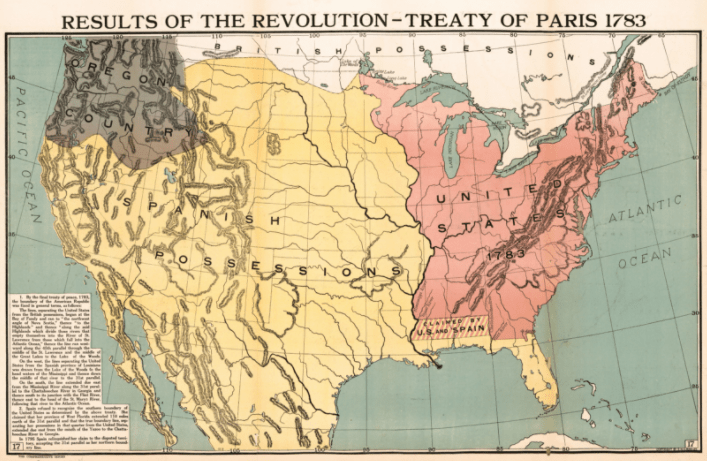
The terms of the treaty stretched U.S. territory to the Mississippi River while reserving Canada for Great Britain. Navigation of the Mississippi River remained open to both sides.
Ultimately, eight years after the signing of the Declaration of Independence and more than four years before George Washington became its first president, the United States became an independent nation.
 calvetconnect.blog
The USA did not become a sovereign state on 4 July 1776; the former 13 British colonies broke away and became 13 sovereign states. The USA as a sovereign state began on 4 March 1789 when the US Constitution became operational.
LikeLike
The USA never became a sovereign state.
The Treaty of Paris made each state independently sovereign, and this was not changed by any document to make the USA into a sovereign state; and the US government does not claim this, but on the contrary, simply claims that none of the 13 states was ever a sovereign state, and that “the Union” became a sovereign state by the American Revolution.
Which of course, is an outright lie.
So each state was always a sovereign state, and the USA never was.
LikeLike
In the last paragraph the signing date is mistakenly referenced as 1783
LikeLike
Thanks, John! It’s been corrected.
LikeLike
Please, reread the Paris Peace Treaty again. This treaty, signed on 3 September 1783, between the American colonies and Great Britain, ended the American Revolution and formally recognized the United States as 13 sovereign states.
Article 1. Britain acknowledges the United States (New Hampshire, Massachusetts Bay, Rhode Island and Providence Plantations, Connecticut, New York, New Jersey, Pennsylvania, Delaware, Maryland, Virginia, North Carolina, South Carolina, and Georgia) to be free, sovereign, and independent states, and that the British Crown and all heirs and successors relinquish claims to the Government, property, and territorial rights of the same, and every part thereof,.
The United States at the time was only referring to the confederation of 13 sovereign states. It was never a single sovereign state until 4 March 1789.
LikeLike
I counted 14 states above, you said 13 sovereign states.
Please explain?
LikeLike
And speaking of accents, you must tell the story of the Holly King and Oak King with Lucy’s haunting English accent. Have background atmospheric music to but the story in its proper listening mood.
The Paris Peace Treaty of September 3, 1783, stated that Great Britain acknowledged the United States to be 13 sovereign states. This is clearly stated in Article I “His Brittanic Majesty acknowledges the said United States, viz., New Hampshire, Massachusetts Bay, Rhode Island and Providence Plantations, Connecticut, New York, New Jersey, Pennsylvania, Maryland, Virginia, North Carolina, South Carolina and Georgia, to be free sovereign and independent states, that he treats with them as such, and for himself, his heirs, and successors, relinquishes all claims to the government, propriety, and territorial rights of the same and every part thereof.”
It is stated:
In testimony whereof, we have caused the seal of the United States to be hereunto affixed. Witness his Excellency Thomas Mifflin, our President, this fourteenth day of January in the year of our Lord one thousand seven hundred and eighty four and in the eighth year of the sovereignty and independence of the United States of America.
This is the ratification of Paris Peace treaty. The Paris Peace treaty clearly recognize the former 13 former colonies as 13 sovereign states. The ratification is not clear if it were really referring to United States as a confederacy of 13 sovereign states. Do you have other documents to specifically state the ratification in detail?
If this is the case, then the confederacy would have been terminated on 14 January 1784. What form of government came after? And why have a constitutional convention to fix the Articles of Confederation in May 1787?
LikeLike
I added the first two lines by accident. Sorry for the error. Just ignore the first two lines.
LikeLike
As you write, “This is the ratification of Paris Peace treaty. The Paris Peace treaty clearly recognize the former 13 former colonies as 13 sovereign states. The ratification is not clear if it were really referring to United States as a confederacy of 13 sovereign states.”
Except that a “confederacy,” by definition, is a union of sovereign states.
Therefore the ratification is quite clear that it was a confederation of 13 sovereign states, by the fact that it recognized each state, by name to be a free, sovereign and independent state; and says that “he treats with them as such,” in reference to King George treating with the 13 states as free, sovereign and independent states.
It does not recognize the United States as a sovereign state.
And contextually, the states declared themselves to be thirteen free and independent states from 1776 on, and expressly retained that status in the 1781 Articles of Confederation.
So the states were definitely sovereign states, under the Treaty of Paris; and this was exercised and demonstrated when some states wished to alter their confederated status in 1787, and they each did so independently of the others, by their own authority as sovereign states.
LikeLike
Rhode Island and Providence Colonies were one and the same.
LikeLiked by 1 person
“On January 14, 1784, the Continental Congress officially declared the sovereignty of the United States of America by ratifying the Paris Treaty. ”
This conflicts with the Articles of Confederation in which all 13 former states were 13 free and independent states. If this really was the case, then there would be no need for constitutional convention in May 1789.
LikeLike
The US government does not claim national union via the Constitution (i.e. alleging that each of the 13 states state lawfully and intentionally gave up its status as sovereign nation, and knowingly and voluntarily subjected itself to Total War at the whim of the other 12);
but rather, it simply claims that the states were never 13 sovereign nations: not in 1776, not in 1783, not in 1789– not EVER.
As noted in Lincoln’s July 4th, 1861 Message to Congress:
And this follows from Jackson’s Nullification Speech, where he claimed that the Declaration of Independence formed a “one nation,” by which he thus claimed that secession was “treason.”
So in reality, the United States was never a sovereign nation– and the individual states always were.
LikeLike
From the Library of Congress: ” The Continental Congress ratified the Treaty of Paris on January 14, 1784, officially establishing the United States as an independent and sovereign nation. The Continental Congress approved preliminary articles of peace on April 15, 1783. The treaty, signed in Paris on September 3, 1783, required Congress to return the ratified document to England within six months.”
LikeLike
Hmm…the Paris Peace Treaty, Article I says differently. What is the official US government statement on this?
And why was there a Constitutional Convention that scrapped the Articles of Confederation in 1987? If the USA was a sovereign state in 1784 then the Articles of Confederation would cease to exist in 1784.
LikeLike
Read the Treaty:
>>”His Britannic Majesty acknowledges the said United States, viz.,
New Hampshire, Massachusetts Bay, Rhode Island and Providence Plantations, Connecticut, New York, New Jersey, Pennsylvania, Delaware, Maryland, Virginia, North Carolina, South Carolina and Georgia,
to be free sovereign and Independent States;
that he treats with them as such,”
and for himself his Heirs & Successors, relinquishes all claims to the Government, Propriety, and Territorial Rights of the same and every Part thereof.
Note that it does not establish the United States as an independent and sovereign nation; but rather as thirteen “free, sovereign and independent states“;
and further says that “he treats with them as such”, meaning King George treated not with any “independent and sovereign nation,” but with the individual states.
“The United States” was simply their international proxy, i.e. a confederation of 13 sovereign nations.
LikeLike
From the Library of Congress: https://www.loc.gov/item/today-in-history/january-14/#:~:text=The%20Continental%20Congress%20ratified%20the,peace%20on%20April%2015%2C%201783.
LikeLike
So why was there a Constitutional Convention in 1787? What is the official US government on this? And what form of government did this sovereign state have from 14 January 1784 to 3 March 1789?
LikeLike
The Constitutional Convention was held, because some of the states wished to amend the Articles of Confederation;
but Rhode Island didn’t agree, and Article XIII required unanimity on all changes to the Articles.
So since the Confederation was an international union of 13 free, sovereign and independent states; then
the other states simply exercised their sovereignty, to secede from the Confederation, and form a new and separate union under the Constitution instead.
And the Constitution did not change any state’s sovereignty.
However starting in 1832, Andrew Jackson became the president to claim that the states were never 13 free, sovereign and independent states; but only that they had always been dependent states, on the United States as a “national union,” claiming that secession from it was “treason…” and Congress concurred, by ratifying his “Force Bill” in 1833.
And the rest is history, with Lincoln likewise expressly claiming in his July 4th Message to Congress:
So in reality, the US government made no valid legal argument of national union over any state; but just falsely claimed the legal right, and used war to make truth its first casualty.
But legally, the states remain separate sovereign nations, while the United States was never soveriegn.
LikeLike
The Continental Congress ratified the Treaty of Paris on 14 January 1784. This means they approved the Treaty of Paris, which clearly states Great Britain recognized the former 13 colonies as 13 free and independent or 13 sovereign states.
LikeLike
13 sovereign states, not a sovereign state.
Can’t you count?
LikeLike
Larry bell is correct. The USA started on 4 March 1789 as a sovereign state.
LikeLike
At last, somebody is reading accurate US history.
LikeLike
No.
The Constitution did not change any state’s sovereignty; since the US government only claimed national union in 1832 under the Jackson Administration, by claiming that the states formed a national union in 1776: and alleging that no state was ever sovereign, but that all 13 were dependent state of this “independent national union.”
However the 1783 Treat of Paris, expressly recognizes the states as 13 “free, sovereign and independent states–” i.e. 13 sovereign nations; and the treaty is between them as such, and Great Britain– while “the United States” is only mentioned as a union among them, not a sovereign state to which they were dependent.
LikeLike
No.
The Constitution did not change any state’s sovereignty; since the US government only claimed national union in 1832 under the Jackson Administration, by claiming that the states formed a national union in 1776: and alleging that no state was ever sovereign, but that all 13 were dependent state of this “independent national union.”
However the 1783 Treat of Paris, expressly recognizes the states as 13 “free, sovereign and independent states–” i.e. 13 sovereign nations; and the treaty is between them as such, and Great Britain– while “the United States” is only mentioned as a union among them, not a sovereign state to which they were dependent.
LikeLike
No, Hannah, you are wrong again. Without repeating myself in detail, here is what happened:
4 July 1777: 13 British colonies broke away from Great Britian and became 13 sovereign states. This was stated in the Declaration of Independence.
1 March 1781: The 13 sovereign states formed a confederation under the Articles of Confederation. The Articles of Confederation was a set of rules for the 13 sovereign states to work together, but the Articles of Confederation never overrode the sovereignty of the member states.
1783 to 1787: The confederation did not work well, so representatives from the member states got together in Philadelphia from May to September 1787 to fix the confederation. After several months of debates and discussions, it was determined to scrap the confederation and replace it with something better. It was determined to form one sovereign state with the sovereign states becoming political divisions, but with realistic and practical autonomy. The form of government for this new sovereign state was a federal republic government, outlined in the US Constitution. The US Constitution was ratified by sovereign states. It was determined to for the new sovereign state to begin on 4 March 1789.
4 March 1789: The USA began as a sovereign state.
LikeLike
The Treaty of Paris did not make the United States into a sovereign nation, since each state was free, sovereign and independent; and the treaty was between them and Great Britain, with the United States only being a proxy.
Meanwhile the Constitution did not change this; because in claiming national union, the US government only argued that the states were never thirteen sovereign nations; it never argued that they gave up that sovereignty (which would be absurd, claiming that each of thirteen sovereign nations would legally and voluntarily subject themselves to Total War at the whim of the other twelve).
LikeLike
The United States never became an independent nation, since the 1783 Treaty expressly recognize each state as free, sovereign and independent; and treats with them as such, with Great Britain recognizing the United States only by virtue of their sovereignty, not as a sovereign state itself.
Meanwhile the Constitution did not change any state’s sovereignty; since the US government only claimed national union in 1832 under the Jackson Administration, by claiming that the states formed a national union in 1776: and alleging that no state was ever sovereign, but that all 13 were dependent state of this “independent national union.”
LikeLike