
H is for hero, and Army veteran Jose Chavez definitely qualifies. He earned a Bronze Star, two Purple Hearts, and other medals the only way you can get them — the hard way — in Iraq in 2009.
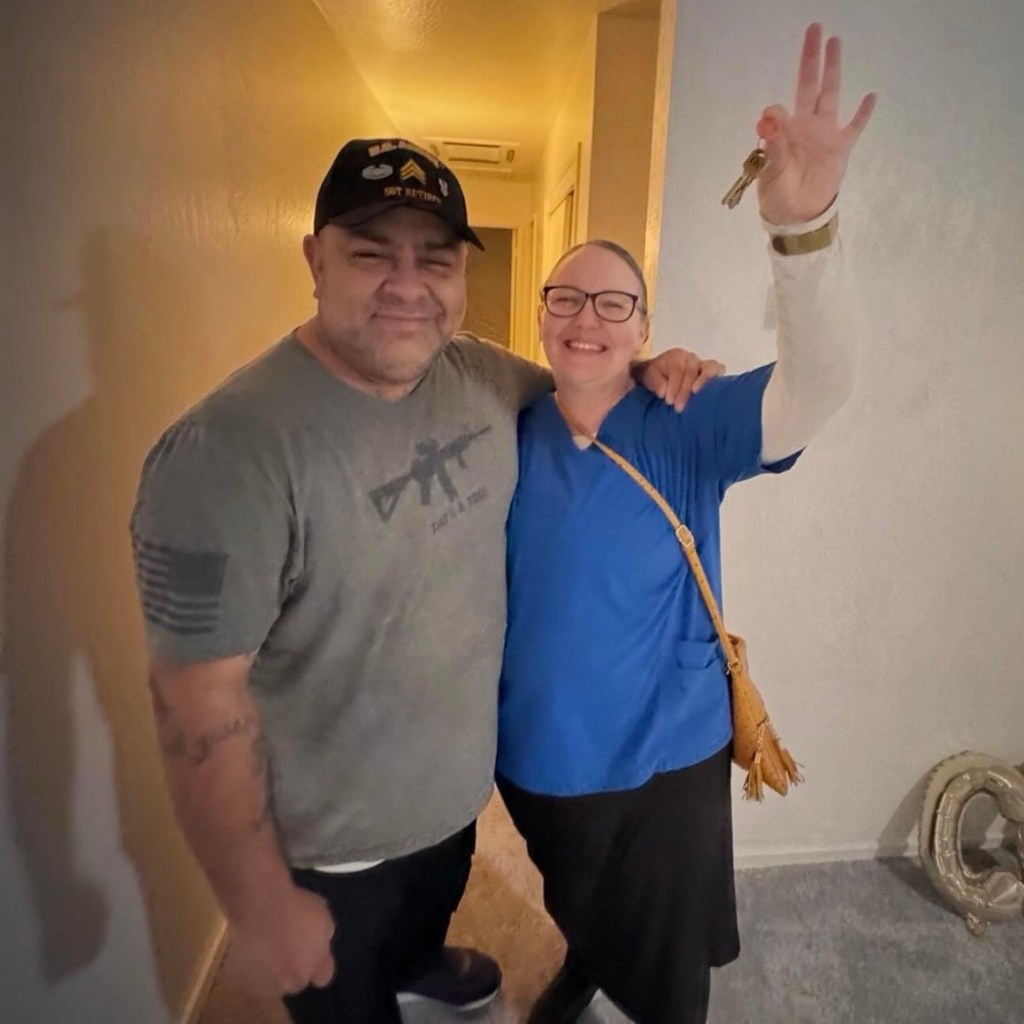
H is also for home, which Chavez and his wife, Melissa, moved into in Sacramento County recently thanks to another important H — a Home Loan from CalVet.
And H is for Hispanic Heritage Month (September 15-October 15), a time when CalVet honors the state’s 285,000 Hispanic veterans, Chavez among them.
Indeed, he hits the H home run, and more.
Born in Salinas, Chavez’s family moved to the Central Valley when he was a young boy.
“I grew up poor and Hispanic in Atwater,” he said. “It was rough going.”
But there he met Melissa, and they married in 2001, with the first of their four children arriving a year later. The family moved to Tucson, Arizona, where he went to work in the pest control business. Following the 9/11 terrorist attacks, he enlisted in the Army and was assigned to infantry and artillery. His unit deployed to Mosul, Iraq, in April 2003.
“We were supposed to be there for 6 months,” he said. “We did not return for 14 months.”
He deployed again in 2005, this time to the Al-Asad base in western Iraq in support of a Marine Corps unit. In 2006, his world changed in an instant.
“We were on a security convoy in a five-ton armored truck, headed for Fallujah,” Chavez, then a sergeant, said. “We ran over an IED (improvised explosive device) as we went under a bridge. I saw the road coming up at me in slow motion. I was thrown into a gully on the side. I woke up and my legs were on fire. I had facial injuries, broken ribs, and a broken jaw.”
As he regained consciousness, the insurgents opened fire. Despite his injuries, he got the gunner to hand him a loaded M240 weapon.
“I remember firing at the bridge and shooting a couple of insurgents,” Chavez said. When the Marines arrived to extract him and other wounded, the enemy kept up their assault. “They were shooting at the medevac (helicopter). I felt like something was biting me. I’d been shot.”
The round struck his leg, and for a time doctors feared they might have to amputate, but ultimately did not. He received one Purple Heart from Brigadier General (Retired) Rebecca Halstead for the IED blast and the second from a colonel for the bullet wound suffered during his evacuation.
He also suffered a traumatic brain injury which, along with the burns he suffered, sent him into a coma and back home to Brooke Army Medical Center in San Antonio.
“I woke up a month or two later,” Chavez said.
While in the burn unit he heard the shouts and cries of others who were in extreme pain from the removal of dead skin as part of the treatment, which also included cleaning the wounds with a chemical solution. Then it was his turn. His condition limited the amount of painkiller doctors could administer, he said.
“They gave me towels to bite down on,” Chavez said. “I screamed bloody murder. I understood why (the other burn patients) had been screaming.”
After nearly a year in the hospital, he was discharged and sent to Fort Bragg, NC. (since renamed Fort Liberty), where he became involved with the Wounded Warriors program.
“I shook hands with Vice President Cheney and Michelle Obama,” Chavez said. He was interviewed for the Military Order of the Purple Heart, telling the interviewer he was thrilled to be there. “I got hurt,” Chavez said. “It’s part of it. I was just happy to be alive.”
That comment merited a summons by his commanding officer, who commended him and handed him $1,000 collected from members of his unit.
Honorably discharged in 2009, Chavez and his family returned to Arizona and back to the pest control business, but the work was too physically demanding for his injuries. So was the landscaping business, which he also tried. Despite his war wounds, his disability rating was only 40% and provided only $400 a month. His wife worked in a dental office. Bills piled up, he said. Their dream of ever owning a home seemed increasingly elusive.
They decided to return home to Atwater, California, living in their RV before renting a place in Sacramento in 2022. Eventually, a friend helped Chavez secure his 100% disability rating that more than doubled his monthly benefit. With Melissa’s salary, they had an improved cash flow and revived their goal of home ownership.
In May, he contacted CalVet, where Loan Originator Eric Myrdal began working with them to qualify for a loan.
“We’d heard nothing but great things, positive things about CalVet,” Chavez said.
After looking at homes for more than a month, they found the one they wanted. After hearing Chavez’s story, the seller reduced the asking price to $450,000. Then, it became a matter of making the deal work, Myrdal said.
“They had zero credit,” he said. “They were in a five-year Chapter 13 (bankruptcy) payback program. The VA is flexible with those after they’ve completed one year. There was still lots of work to do, but Jose and Melissa were different — they actually did work at it.”
Because CalVet can base its loans not on credit scores but instead on the veteran’s ability to repay, it could underwrite their loan.
“We (CalVet) have the flexibility to do that.” Myrdal said.
On August, 30, the Chavez family moved into their new residence in Sacramento.
“What can I ever say but thank you so much CalVet for making my dream come true,” Chavez said. “I almost died in Iraq. But can you believe it? Now I own a part of this country I love so much.”
A hero and his family in their new home, a CalVet Home Loan, and in time for Hispanic Heritage Month. The H home run completed, with an additional H for good measure: Happiness. Much, much happiness.
For more information on obtaining a CalVet Home Loan, visit calvet.ca.gov/homeloans or call us directly during regular business hours at (866) 653-2510. We are happy to help.
 calvetconnect.blog