
In the spring of 1967, the most futuristic television show of its time appeared headed into a black hole of oblivion.
Driving up Highway 99 through the Central Valley, in a Volkswagen Bug with two kids in the back seat and no air conditioning, John and Bjo Trimble vowed to go where no fans had gone before: they would mount a campaign to save the original “Star Trek” series from cancellation, or at least buy it a vital third season.
The Trimbles, now residents of the Veterans Home of California-Chula Vista, started a “Save Star Trek” letter-writing campaign aimed at prodding NBC executives into renewing the show for 1968-69. Had the Trimbles failed, “Star Trek” would have lacked the three seasons needed to send it into reruns and syndication, where it developed its real fan base. The franchise it begat included—“The Next Generation” (1987–1994), “Deep Space Nine” (1993–1999), “Voyager” (1995–2001), “Enterprise” (2001–2005), “Streaming Discovery” (2017–present), “Picard” (2020–2023), and “Strange New Worlds” (2022–present)—likely never would have materialized. Nor would the shows have become fun fodder for “Saturday Night Live” skits.
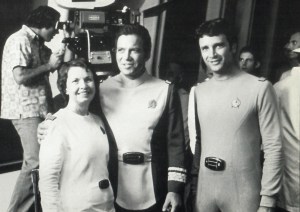
How did the Trimbles become so deeply entrenched in a show that lasted only three seasons but developed a cult following that remains alive and thriving to this day?
“It really started with a friend who couldn’t go to a convention to handle a futuristic fashion show in Cleveland,” said Bjo Trimble, a longtime science fiction fan who stepped in to help with the 1966 event. Bjo—short for Betty Jo—celebrated her 90th birthday on August 15. “I was handed a bunch of notes. I had an hour to show 20 costumes.”
She was told the show had promised a big-time Hollywood producer could enter three costumes into her show.
“I told him I couldn’t do three more in the time they’d given me,” she replied,
Moments later, “Star Trek” producer Gene Roddenberry himself approached her and introduced himself.
“I’d never heard of ‘Star Trek,’” Bjo said. Of course not. It hadn’t premiered at that point. Roddenberry wanted to showcase the costumes to promote his new TV show. “The next thing I knew, he’d talked his way into the fashion show.”
The costumes—used in Episodes 6 and 7 of Season 1—were “very revealing,” Bjo Trimble said. “As much as you could get away with then.”
While Roddenberry voiced his appreciation, she was skeptical when he told her, “When you get to Hollywood, give me a call and we’ll do lunch,” she said.
When the Trimbles did make it to Hollywood, she called. Roddenberry took the call personally. They had lunch and became friends. Roddenberry invited them to watch the filming of the show at the old Desilu Studios created by “I Love Lucy” stars Lucille Ball and Desi Arnaz.
“We had carte blanche,” John Trimble said. “We could visit the set whenever they were filming.”
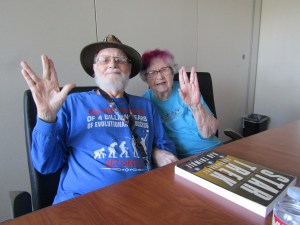
As the 1967-68 (second) season filming neared its end, the Trimbles noticed that members of the cast and crew seemed glum once the cameras stopped rolling. They sensed something was wrong, and asked questions until they learned what caused all of the long faces: the network planned to cancel the show after its second season due to its low Nielsen ratings.
“The Nielsens were the holy grail of TV,” Bjo Trimble said. But, she said, the agency’s surveys were weighted to favor family shows, and not science fiction or crime dramas. NBC, which aired “Star Trek,” intended to yank the show from the 1968-69 lineup.
Talking in the car while heading back home to the Bay Area and Oakland, where John’s employer had reassigned him to work, the Trimbles became determined to save the show, and decided they would bombard the network with letters from anyone they could recruit to help.
“We got a friend who was a book dealer to send us their mailing list,” John Trimble said. Friends provided Christmas card mailing lists and business lists and any other list they could get their hands on—legally and ethically, of course. Then, they sent letters asking each person to write letters to the network, and what to include, and to do the same with their friends, customers, and acquaintances.
“What to say and what not to say,” John Trimble said. “Don’t threaten anybody.”
They have no idea how many people actually wrote letters to NBC. They only know their letter-writing campaign approach worked. The network aired an assurance to “Star Trek” fans the show would live to see a third season in 1968-69.
“And to please stop writing letters,” Bjo said. “Then they got several thousand ‘thank-you’ letters.”

The Trimbles also played a role in getting NASA to change the name of the first Space Shuttle from the Constitution to Enterprise, the latter being the name of the starship in the original Star Trek series. She attended the rollout of the Enterprise shuttle in 1976 in Palmdale. She couldn’t score a VIP pass, but did finagle a press badge that provided a much closer view of the spacecraft “and all the neat stuff,” she said, referring to bling that came with the press kit.
Bjo Trimble published a memoir titled “On the Good Ship Enterprise: My 15 Years with Star Trek” and the “Star Trek Concordance.” The latter included endorsements from “Star Trek” stars William Shatner and George Takei on the back cover.
Shatner, in fact, wrote “Nobody knows more about Star Trek than Bjo Trimble. She’s taught me a thing or two, and I love that.”
It’s been quite a voyage, indeed.
“We’re part of the ‘Star Trek’ legacy,” she said. “We hope to see that last.”
The Veterans Home of California-Chula Vista is one of eight Veterans Homes of California across the state. The homes offer affordable long-term care to older and disabled veterans as well as their eligible spouses and domestic partners. The services offered at each of the eight homes varies and range from assisted living programs with minimal support to 24-hour skilled nursing care for veterans with significant clinical needs including memory care.
CalVet staff are uniquely capable of serving the needs of our veterans and provide an environment that honors their service to the country. The Veterans Homes are nationally recognized for the premier care and services they provide to California’s veterans. For more information visit www.calvet.ca.gov/calvet-programs/veteran-homes.
 calvetconnect.blog
Love this!
LikeLike