
CHULA VISTA – When Richard Mowrey sat during a portrait session at the Veterans Homes of California-Chula Vista one recent afternoon, he was “Richard.” Or “Mr. Mowrey.”
That all changed the moment photographer Mickey Strand asked Mowrey his rank in the U.S. Navy. Mowrey replied, “CPO.”
From that moment on, Mowrey—whose Navy career as a propulsion engineer began during the Korean War (1950-53), promoted to Chief Petty Officer in 1961, and ended his military service in 1968—was simply “Chief.” OK, Chief Emeritus, Strand explained.
“You find a brother who is a chief, and he’s ‘Chief,’” said Strand, who also rose to Chief Petty Officer during his own Navy career before retiring and opening his own photography studio. “His name is not Richard. He’s ‘Chief’—always ‘Chief.’”
By chatting them up that way, Strand got to know a bit about each of the 26 Korean War Era veterans who sat for the deep and detailed black-and-white portraits that soon will be on display at the Home as part of his “Yesterday’s Heroes” project.
“This is a great way to honor our veterans and to demonstrate how much they mean to us,” said Coby Petersen, CalVet deputy secretary for the Veterans Homes Division. “It’s there for everyone to enjoy and to see as they enter into our facilities. Each of these portraits—these faces—tells a story of service.”

In fact, Strand’s portraits of the Korean War veterans soon will replace the 25 World War II veterans currently displayed on columns within the facility. Of those—all of whom were residents at the Chula Vista Home when he photographed them in 2018—only one, Harry Greenberg, still lives there. The rest, like so many others of the rapidly declining “Greatest Generation,” have passed. Their portraits will be relocated to be displayed prominently on a single wall elsewhere in the Home.
“Our veterans love them and feel very valued that we invested in them and their stories,” Chula Vista Home Administrator Thuy Mascorro said. “He’s (Strand is) the true hero of this project because he’s able to capture the essence of our veterans through their expressions and stories.”
The Korean War Era portraits—July 27 marks the 70th anniversary of the armistice that ended the fighting in 1953—will go front and center in a project that has become Strand’s passion. He spent 24 years in the Navy aboard ships, with tours of duty as an embedded photographer in Afghanistan and Iraq, and as a base photographer at Miramar Naval Air Station near San Diego, his hometown. Strand later taught photography for four years at the Defense Information School at Fort Meade, Maryland.
When a mentor challenged him to step up the quality of his portrait artistry, he found no better subjects than veterans. He’s photographed World War II veterans at Veterans Homes of California in West Los Angeles and Ventura. His work took him to NBC’s “Today” show, where he was interviewed by Harry Smith in September 2022.
That Strand does much of his work out of pocket, with occasional help from a sponsor, speaks volumes.
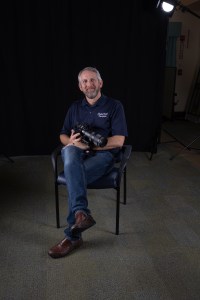
“I love (our) veterans more than I love making money,” he said.
Strand generally begins each shoot by interviewing the veteran, recording it on his phone. At first, he intended to get just enough information for a basic caption to accompany the portrait. But when many of them began to open up, he realized the project could be much more.
“I’ve learned to shut up and let them tell their stories,” Strand said.
One veteran told him about being a paratrooper in Holland during World War II, separated from his unit along with his lieutenant and taking cover in a ditch when a pair of German soldiers approached.
“(The unit) needed (the lieutenant) more than me,” he told Strand.
The veteran then revealed something he’d held within since the war: that he shot and killed those two German soldiers.
“He looked me right in the eye and said, ‘It was the hardest thing I’ve ever had to do,’” Strand said.
It was a story the veteran’s daughter, who accompanied him to the session, had never heard before. He teared up telling the story. She teared up hearing it.
“For 75 years, he’d held onto to it (that memory) and remembered doing it,” Strand said. “He relieved his burden by telling me.”
Strand’s portraits often depict both a veteran’s pain and relief at the moment.
Bill Purcell, a Navy veteran who also served at Miramar before working in the entertainment industry and with NFL Films, now resides at the Chula Vista Home. He assisted Strand during the session there, and was also moved by what he heard and saw.
“The more they become involved in the interviews, they go back to those times in their lives, good and bad,” Purcell said
Strand aims to capture the blend of contours, wrinkles, and all else that reflects their dignity and years.
He frequently uses props to give the portraits their own distinctive feel—like photographing one Chula Vista veteran holding a clarinet.
“Some will bring photos of their crew, or a ship’s or World War II or Korean War (ballcap),” Strand said. “I usually bring my grandfather’s casket flag. It’s great to let them hold the flag, cradle it.”
Veteran Oliver Luck wished he would have brought along the instrument he played in the Air Force Band, and with Cab Calloway, Duke Ellington, Bing Crosby, and Sammy Davis Jr., as well as appearing in scores of movies, television shows, and even a Prince video.
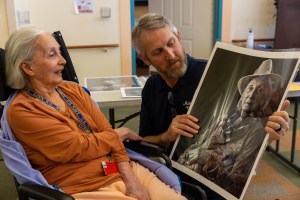
His photo in the lobby of the Chula Vista Home represents a different kind of special, he said.
“I feel honored,” Luck said. “People are saying, ‘Why didn’t you have your trombone with you up there?’”
Strand presented a finished portrait to veteran Antoinette Lamb, telling her it will soon be featured in the Home’s lobby.
“These are nice,” she said. It brought back memories of her time in the Navy in the early 1950s.
“I was stationed at Great Lakes,” she said, with a twinkle in her eye. “There were lots of good-looking guys there.”
Indeed, he captures so much more than just faces. These portraits define veterans and their eras, their memories, and sometimes what they still keep inside.
Which brings us back to Mowrey, or “Chief.”
Strand asked Mowrey to stroke his beard for one shot. Mowrey shot him a glance that left Strand asking, “Are you angry with me?”
Purcell answered on Mowrey’s behalf.
“Not angry,” Purcell interjected. “That’s just his Chief’s look.”
Visit mickeystrand.com for more information on Strand’s photography work. To see his veterans’ portraits, go to veteransportrait.com.
The Veterans Homes of California system of care offers affordable long-term care to older and disabled veterans as well as their eligible spouses and domestic partners. With eight facilities across the state, the services offered range from assisted living programs with minimal support to 24-hour skilled nursing care for veterans with significant clinical needs including memory care. CalVet staff are uniquely capable of serving the needs of our veterans and provide an environment that honors their service to the country. The Veterans Homes are nationally recognized for the premier care and services they provide to California’s veterans.
 calvetconnect.blog
Beautiful story to read.
LikeLike